
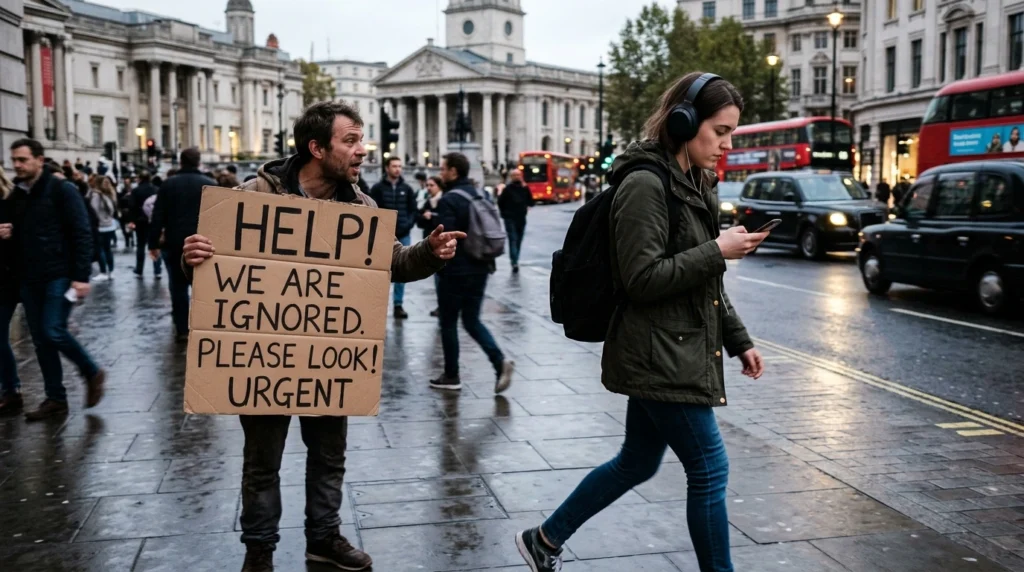
What Does “Turn a Blind Eye” Mean?
The phrase “turn a blind eye” means to ignore something on purpose, even when you know it is wrong or happening.
It is a metaphor for ignoring something because it describes choosing not to “see” a problem.
Simple Meaning:
- To ignore something deliberately
- To avoid noticing a problem
- To pretend something is not happening
Grammar Note:
It is an idiom used in everyday English, especially in business communication, stories, and real-life conversations.
Examples:
- The teacher turned a blind eye to the late homework.
- The manager turned a blind eye to small mistakes.
Is “Turn a Blind Eye” a Correct Expression?
Yes, it is 100% correct English.
However, learners sometimes misuse it because:
- It sounds literal (like actually closing eyes)
- It is a fixed idiom, not a normal sentence structure
Common Learner Mistake:
❌ He blind eye the problem.
✔ He turned a blind eye to the problem.

Metaphor for Ignoring Something – Key Differences
| Feature | Turn a Blind Eye | Literal Ignoring |
|---|---|---|
| Meaning | Deliberate ignoring | Not noticing |
| Usage | Idiom (metaphor for ignoring something) | Normal action |
| Example | She turned a blind eye to rules | She did not see the rules |
Real-Life Examples (Very Important)
1.
A: Did the boss notice the delay?
B: Yes, but he turned a blind eye.
🎯 Lesson: People sometimes ignore problems on purpose.
2.
The teacher saw cheating but turned a blind eye.
🎯 Lesson: Ignoring small mistakes is sometimes allowed.
3.
My parents turned a blind eye to my late-night studying.
🎯 Lesson: Ignoring behavior can be intentional.
4.
The officer turned a blind eye to minor violations.
🎯 Lesson: Rules are not always strictly enforced.
5.
She turned a blind eye to his rude comments.
🎯 Lesson: Emotional tolerance can mean ignoring issues.
When to Use “Turn a Blind Eye” Correctly
Use this metaphor for ignoring something in situations like:
- Workplace situations
- School or classroom behavior
- Small rule violations
- Everyday conversations
- Storytelling or writing
Common Mistakes Learners Make
- ❌ Using it literally (“I turned my blind eye”)
✔ Correct: “I turned a blind eye” - ❌ Forgetting “to” after the phrase
✔ Correct: “turn a blind eye to something” - ❌ Using it for physical vision problems
✔ It is NOT about eyesight - ❌ Mixing word order
✔ Fixed phrase must stay the same
Quick Memory Trick (Easy Rule)
Think of it like this:
👉 “Blind eye = pretend you did not see it”
So whenever you want to ignore a problem on purpose, imagine closing one imaginary eye to reality.
This simple trick helps you remember the metaphor for ignoring something easily in real conversations.